Ref. No. 725
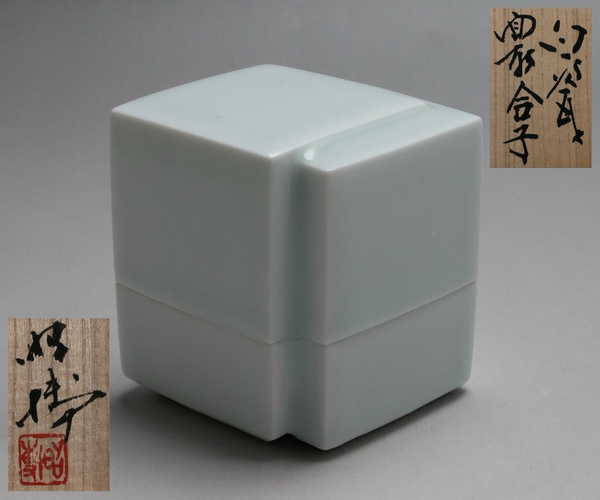
Faceted White Porcelain (Hakuji) Box by MAETA Akihiro (b. 1954) by Akihiro MAETA
| Origin | Japan |
|---|---|
| Period | Heisei period (1989-2019) |
| Medium | Ceramic |
| Dimensions |
Height6.8 cm / 2 43⁄64 in
Width6 cm / 2 23⁄64 in
|
| Tomobako | Included |
| Condition | Excellent |
Provenance
- Private Japanese collection
Short Description
A small covered box (gosu) of cubic form, the body cut with broad faceted planes (mentori) that descend from a gently domed lid to a straight, angular foot, the facets meeting in a soft ridge along each corner. Covered overall in a clear glaze pooling with a faint blue-white tone in the recesses of the facets, over a fine white porcelain body. Signed in underglaze beneath the base. Comes with the original tomobako and cloth wrapper (shifuku). Minute (glaze-) chip to one corner of the base.
Maeta Akihiro was born in 1954 in Tottori Prefecture and graduated from Osaka University of Arts in 1977, majoring in ceramics. He developed his signature mentori (faceting) technique early in his career, cutting flat planes into leather-hard thrown forms before applying a clear glaze, producing the interplay of light and shadow across the surface for which his work is known. He deliberately describes his material with an alternative first character to the conventional word for hakuji, one he associates with the warmth of stoneware rather than the coolness typically associated with porcelain.
His career honours include the Mainichi Shimbun Prize at the 11th Japan Ceramic Art Exhibition (1991), the Tomimoto Prize at the 48th Shinshō Craft Exhibition (1993), the Asahi Shimbun Prize at the 47th Japan Traditional Art Crafts Exhibition (2000), the Japan Ceramic Society Award (2004), the Medal with Purple Ribbon (2007), and designation as a holder of Tottori Prefecture Intangible Cultural Property in ceramics (2012). In 2013 he was designated a holder of Important Intangible Cultural Property for hakuji — a Living National Treasure — the first recipient of this honour from Tottori Prefecture. In 2024 he received the Order of the Rising Sun, Gold Rays with Rosette. He serves as chairman of the ceramics division of the Japan Kōgei Association and as a guest professor at his alma mater, Osaka University of Arts.
Compare: For related faceted (mentori) hakuji forms by the artist, see institutional collections including the Museum of Oriental Ceramics, Osaka; the National Museum of Modern Art, Tokyo; the Imperial Household Agency; the Everson Museum of Art; and the Art Gallery of New South Wales.