Ref. No. 730
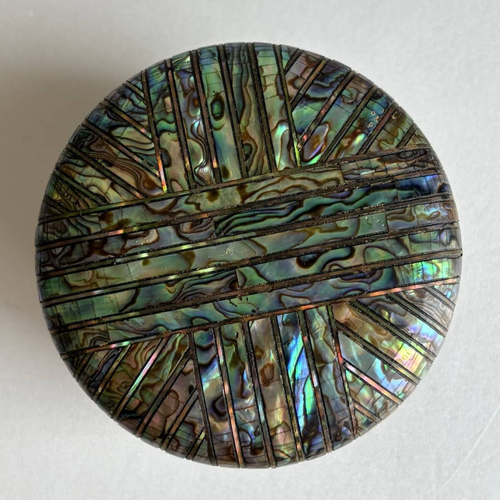
Raden Hira-Natsume
| Origin | Japan |
|---|---|
| Period | Showa period (1926-1989) |
| Medium | Lacquer |
| Dimensions |
Width6.4 cm / 2 33⁄64 in
Diameter8.8 cm / 3 15⁄32 in
|
| Tomobako | Included |
| Condition | Excellent |
Provenance
- Private Japanese collection
Short Description
A hira-natsume of low, rounded form, the entire surface, lid and body, covered edge to edge in narrow strips of thinly-cut abalone shell, set into the lacquer ground in a banded, radiating pattern known as noshigai-bari. The technique is raden, the traditional Japanese practice of inlaying polished shell into lacquer to exploit its natural iridescence; the particular abalone material used here, prized for its blue-green nacre, is termed aogai. On the lid, the strips fan outward from a central point in a pinwheel arrangement, crossed by broader horizontal bands; the body is wrapped in tight horizontal registers of the same shell strips, divided at the join between lid and body. No lacquer ground is visible through the inlay on the exterior, the shell strips being set flush and highly polished to a continuous iridescent surface shifting between green, blue, and amber tones as the light catches the nacre. The interior and base are finished in plain black lacquer. The piece is signed and sealed on the underside of the tomobako lid, read Maehata Mineharu, with a red seal beneath the signature.
Tomobako present, inscribed with the artist’s signature and seal on the lid interior.
Maehata Mineharu is a lacquer artist (nushi) belonging to the Maehata family of the Kaga region, Ishikawa Prefecture, a lacquer house whose generations include Maehata Shunsai (1st and 3rd generation) and Maehata Gaho (2nd generation, b. 1936), known for Yamanaka-nuri and Kaga maki-e work in tea ceremony utensils.