Ref. No. 604
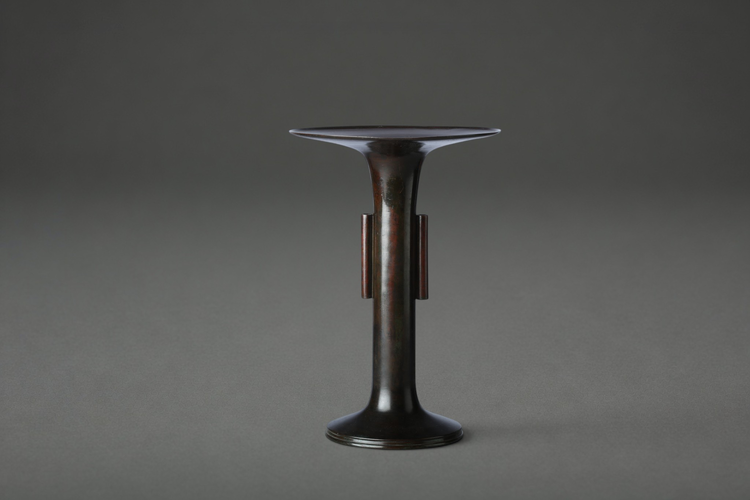
Bronze Usubata Vase
| Origin | Japan |
|---|---|
| Period | Edo period (17th–18th century) |
| Medium | Bronze |
| Dimensions |
Height28.5 cm / 11 7⁄32 in
|
| Condition | Very Good |
Short Description
Of tall, slender form, the cylindrical stem rises from a domed, spreading foot with a stepped base ring. At the top it widens into a broad, shallow mouth with a thin, flat rim, the feature that gives the usubata ("thin edge") its name. A pair of upright rectangular flanges is applied on opposite sides of the stem, a quiet reference to the flanged ritual beakers of ancient China, which Japanese casters often adapted for flower vessels. There is no other decoration. The surface has an even dark brown patina, with warm reddish tones showing through on the stem and flanges.
The usubata is a flower vessel that developed in Japan in the seventeenth century, when bronze flower containers were used for the formal rikka style of arrangement. Its wide, flat rim enlarges the flared mouth of earlier Chinese vases into something new, while the body usually stays close to its Chinese models. On this vase the link is especially clear in the flanges on the stem. Later in the Edo period a variant with a splayed mouth and a small raised lip became fashionable. The traditional flat-rimmed type shown here stayed in use alongside it, as the examples brought to Leiden by Philipp Franz von Siebold in 1829 show.
Compare:
- Flower vase (usubata), cast bronze, 18th or early 19th century, height 19,4 cm, von Siebold collection, Wereldmuseum Leiden; Joe Earle, Flower Bronzes of Japan London: Michael Goedhuis, 1995, pl. 51