Ref. No. 650
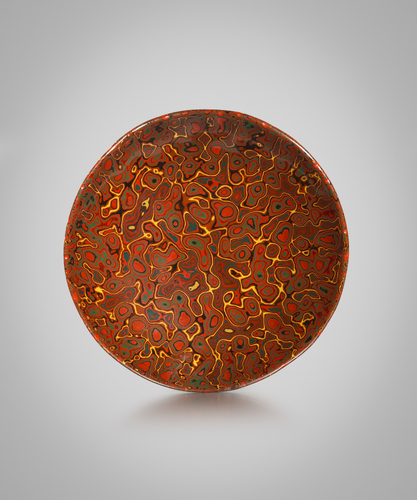
Dry Lacquer Serving Dish by Bijutsu Kogeisha KONISHI
| Origin | Japan |
|---|---|
| Period | Showa period (1926-1989) |
| Medium | Lacquer |
| Dimensions |
Diameter27.5 cm / 10 53⁄64 in
|
| Tomobako | Included |
| Signature | Konishi saku |
Provenance
- Ben Janssens collection, UK
Short Description
A substantial dish of thick construction, shallow and circular with gently curving walls and a softly undulating rim. It is made in dry lacquer and finished in tsuishitsu togidashi, in which successive layers of coloured lacquer are built up and then polished back. Here the technique reveals a dense, swirling pattern of vermilion, green, ochre yellow, black and brown in irregular cells of concentric bands, and the pattern covers both interior and exterior. The base has a raised foot ring in dark brown lacquer. Within it is a vermilion ground mottled with green and black, signed in gold lacquer. The dish comes with its original tomobako, inscribed on the lid with the technique and the description of the dish as a dry lacquer serving dish. Inside the lid it is signed Nikko Konishi Bijutsu Kogeisha saku, with a seal.
Konishi Bijutsu Kogeisha (Konishi Decorative Arts and Crafts) is Japan's foremost specialist in the conservation of the lacquer, polychrome painting and metal fittings of historic shrines and temples. Its origins lie at Nikko, with a craftsman who worked on the great rebuilding of the Toshogu shrine [in 1636]. A Konishi lacquer workshop was later established there [in 1754]. From the Meiji period the firm worked on shrines and temples across Japan. It still conserves the World Heritage shrines and temples of Nikko today. The firm also conserves and makes replicas of lacquer works of art for the Tokyo National Museum, which holds a number of its replicas.