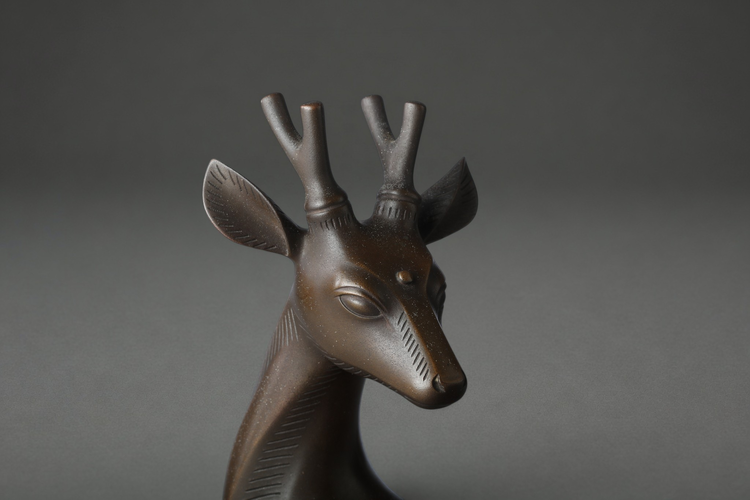
Ref. No. 643
Recumbent Deer by Sanka KITAHARA
| Origin | Japan |
|---|---|
| Period | Showa period (1926-1989) |
| Medium | Bronze |
| Dimensions |
Height21 cm / 8 17⁄64 in
Width30 cm / 11 13⁄16 in
|
| Tomobako | Included |
| Condition | Excellent |
| Signature | Sanka saku |
Provenance
- Japanese private collection
Short Description
A bronze okimono of a deer lying at rest, its long neck curving up from the chest and the head turned back towards its own flank, eyes half-lowered. One foreleg stretches forward and the other legs are folded beneath the body. The forms are reduced to smooth, rounded volumes, set off by fine incised hatching on the throat, muzzle, ears, haunch and fetlocks. Short forked antlers rise from ridged bases. The surface carries a warm brown patina with darker and lighter tones. With a wooden storage box (tomobako), the lid titled shika okimono on the outside and signed imoji Kitahara Sanka saku on the inside, with seal Sanka-in.
Kitahara Sanka, born Kitahara Miyoshi in what is now Iida City, Nagano Prefecture, took his art name from an alternative reading of the characters of his given name. In 1915 he entered the casting course at the Tokyo School of Fine Arts, where he studied casting under Tsuda Shinobu, the history of metalwork under Katori Hotsuma and design under Shimada Yoshinari. His work was first accepted at the Teiten in 1927, in its newly established crafts section, and he received special prizes (tokusen) there in 1931, 1932 and 1933. In 1930 he joined Nanoka-kai, the study group around Katori Hotsuma, whose principles held that modern craft should be shaped as much by the study of historical works as by contemporary currents. After the war he exhibited at the Nitten and the Shokoten and won prizes at both. His stylised animal bronzes join the Art Deco simplification of form with traditional Japanese casting and modelling.