Ref. No. 696
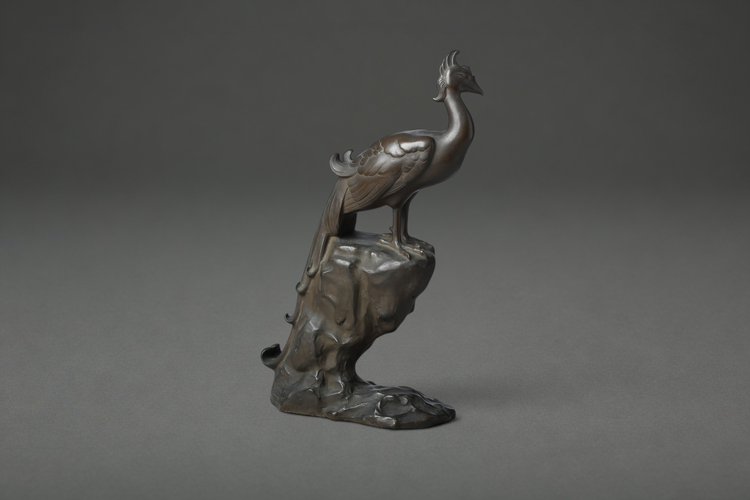
Bronze figure Phoenix on rocks by Shinobu TSUDA
| Origin | Japan |
|---|---|
| Period | Taisho (1912-1926) |
| Medium | Bronze |
| Dimensions |
Height39 cm / 15 23⁄64 in
|
| Tomobako | Not included |
| Condition | Very Good |
| Signature | Daiju |
Provenance
- Private Dutch collection
About This Work
Bronze Phoenix by Tsuda Shinobu (1875-1946)
Japan, Taisho period (1912-1926)
Signed: Daiju
This bronze okimono by Tsuda Shinobu depicts a finely crafted phoenix perched atop a rugged rock formation. The bird is elegantly poised, its head held high with a gracefully curved neck, exuding a sense of dignity and majesty. The sculpted feathers display intricate detailing, with layered wing and tail plumes that gently curve, adding a dynamic sense of movement. The long, flowing tail feathers cascade down the rock, enhancing the composition’s verticality.
Rendered in a smooth, dark bronze finish, the piece showcases Tsuda Shinobu’s mastery of form and material. The contrast between the bird’s refined, polished body and the rough texture of the base creates a striking visual balance. The choice of the phoenix, a symbol of immortality and renewal in East Asian culture, further elevates the significance of the work. This okimono is not just a decorative object but a testament to traditional Japanese metalworking craftsmanship at its finest. The artist’s signature, “Daiju”, is engraved on the lower back of the pedestal.
Tsuda Shinobu (art name: Daiju) (1875–1946)
Tsuda Shinobu (art name Daiju) was a pioneering figure in modern Japanese metalwork, celebrated for both his artistic innovation and his role as an educator. Born in Chiba Prefecture, he graduated from the Tokyo School of Fine Arts in 1900 and soon returned there as an instructor. By 1919, he had become a full professor, shaping the next generation of metal artists and influencing the development of the medium at a national level.
Tsuda’s work is distinguished by a refined balance of traditional Japanese craftsmanship and modernist aesthetics. He specialized in bronze sculpture, producing elegant vases, stylized animals, and small decorative objects (okimono) that often featured organic motifs and a minimalist sensibility. His art was widely exhibited, including at the Tokyo Industrial Exposition of 1907 and the prestigious Paris Exposition of 1925, where he represented Japan on an international stage. He was twice decorated by the French government, in 1928 and again in 1933, for his contributions to the arts.
Beyond his own practice, Tsuda was instrumental in the formation of the Mukei group in 1926, a movement that aimed to reinvigorate Japanese craft traditions through modern approaches. His contributions were further recognized when he was inducted into the Imperial Academy of Fine Arts in 1935, becoming a full member two years later.
Even after his death in 1946, Tsuda’s legacy endured through his students and successors. In recent decades, his work has been revisited and celebrated, most notably in the 2016–2017 retrospective “Giant of Metal Art” at the Chiba Prefectural Museum of Art. Works by him can be found in major museum collections.