Ref. No. 536
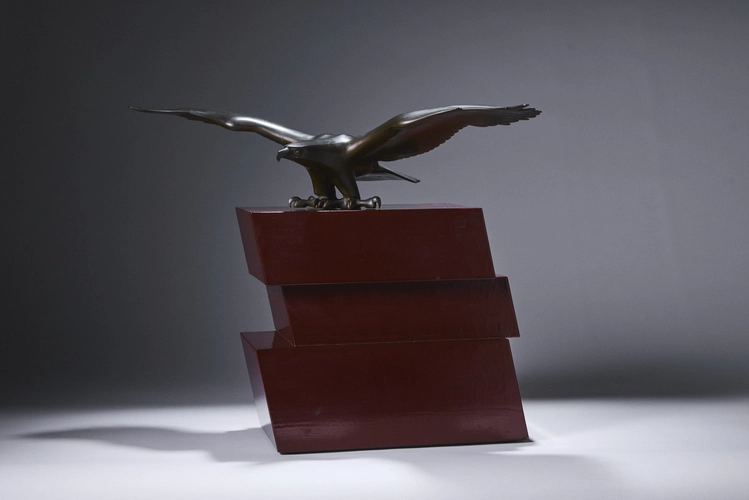
Bronze Okimono of an Eagle on a Rock by Masahiko KATORI
| Origin | Japan |
|---|---|
| Period | Showa period (1926-1989) |
| Medium | Bronze |
| Dimensions |
Width43 cm / 16 59⁄64 in
|
| Tomobako | Not included |
| Condition | Very Good |
Provenance
- Ben Janssens Oriental Art on TEFAF 2012
- Elise Wessels Collection, Amsterdam.
About This Work
Katori Masahiko (1899–1988) – Living National Treasure of Metalwork
Born in Sakura City, Chiba Prefecture, Katori Masahiko was the eldest son of the celebrated bronze artist Katori Hozuma (1874–1954). He began his artistic education studying Western painting at the Taiheiyo Gakai Kenkyujo while apprenticing under his father in metal casting. Later, he enrolled in the metalwork department of the Tokyo School of Fine Arts (now Tokyo University of the Arts), graduating in 1925. That same year, he won a bronze medal at the International Exhibition of Decorative Arts in Paris, marking his early international recognition.
Katori’s work spans a wide range of metal objects, including bowls, flower vases, and Buddhist temple bells, some in collaboration with his father and others created independently. Following World War II, he contributed significantly to the preservation and restoration of Japanese Buddhist artifacts and produced numerous bells for temples across the country.
An influential figure in Japan’s craft community, Katori actively mentored younger artists, contributed to the National Commission for the Preservation of Cultural Properties, and served as director of the Japan Craft Association. In 1977, he was officially designated a Living National Treasure for his mastery of metal casting.
Katori’s legacy lies not only in his technical brilliance and aesthetic refinement but also in his dedication to preserving and advancing Japan’s traditional metalworking heritage.