Ref. No. 752
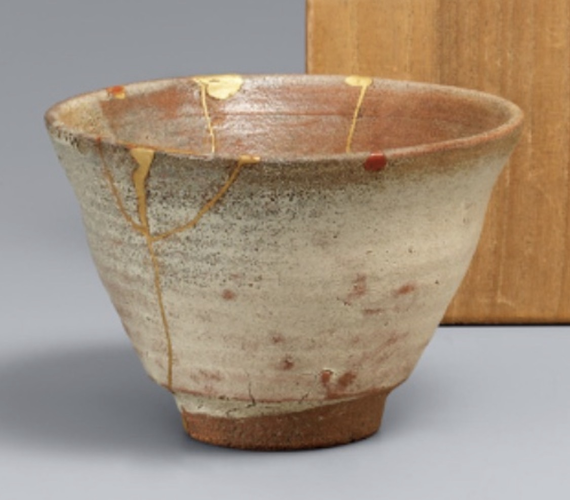
Koido Type Chawan
| Origin | Korea |
|---|---|
| Century | Joseon dynasty, 17th century |
| Medium | Ceramic |
| Dimensions |
Height9 cm / 3 35⁄64 in
Diameter13.7 cm / 5 25⁄64 in
|
| Condition | Good |
Provenance
- Felix Tikotin (1893–1986), Berlin, Germany
- Louis (Loek) Borensztajn (1935–2021), Germany
- A private German collection
Short Description
A tea bowl of deep, gently flaring conical form, thrown from a coarse, iron-rich stoneware with the throwing rings left visible on the exterior, and raised on a sturdy, cleanly trimmed foot. A thin, semi-translucent greyish-white glaze covers the body, letting the reddish clay show through as soft pink and russet blushes scattered with darker iron flecks. Five spur marks remain in the well from stacking in the kiln. Toward the lower body the glaze thins and shrinks into small beads and pits (kairagi) before stopping short of the foot, leaving the foot ring and base bare to reveal the rough, sandy reddish-brown clay. At the centre of the base is a small raised point (tokin) left by the trimming tool, surrounded by fine firing cracks. Chips to the rim and several cracks, including a long one running from the rim down the wall to the foot, are repaired in gold lacquer (kintsugi).
In Japanese tea circles, korai (taken from the name of the Goryeo dynasty) came to stand for all bowls made in Korea, much as karamono covered wares from China, although most date from the later Joseon dynasty. Of all the korai types, ido bowls have been held in the highest esteem since the rise of wabi tea. They were made anonymously in Korea as everyday vessels rather than for tea, and they had reached Japan by the 1570s, when they first appear in the records of tea gatherings. The origin of the name ido remains unknown. Tea connoisseurs distinguish several subtypes, and koido denotes the smaller ido bowls. The prefix ko is written with the character for "small" or "old", both of which are used for the same type. Ido bowls are judged by a set of conventions: a loquat-coloured glaze with fine crackle, visible throwing rings, a bamboo-node foot, kairagi around the foot, a tokin at the centre of the base, and spur marks in the well from stacked firing.
Compare:
- Koido Tea Bowl, Korea, Joseon dynasty, 16th century, Tokyo National Museum
- Ido Tea Bowl, named Kanamori, Korea, Joseon dynasty, 16th century, Miho Museum, Shiga
Condition: Chips, repairs and Kintsugi.