Ref. No. 426
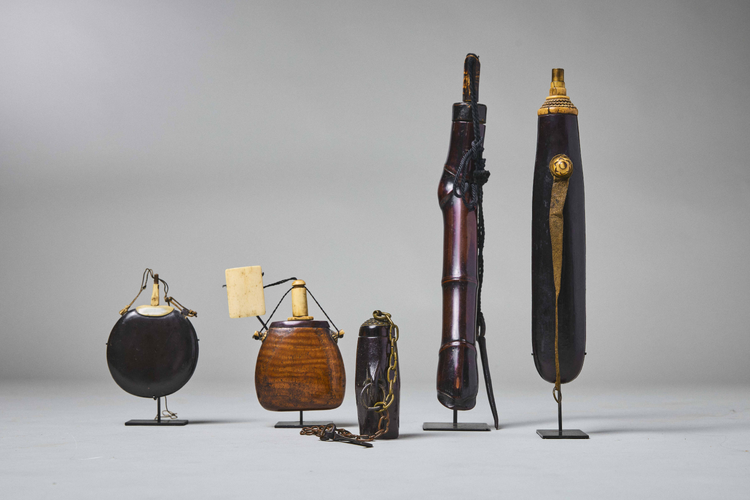
Four Powder Flasks (Kayaku-ire) on Stands
| Origin | Japan |
|---|---|
| Century | Edo period, 18th–19th century |
| Medium | Lacquer |
| Condition | Good |
Provenance
- With Patrick Mesdag Gallery, Belgium
- With, Düsseldorf, Germany
- private collection, Germany
Short Description
A group of four powder flasks for matchlock guns, showing the range of forms and materials used for this equipment. The tallest is made from a naturally curved length of bamboo with its nodes left visible, lacquered a deep reddish brown. Its bend and angled foot give it the look of a deer's leg ending in a hoof, a wry touch for a hunter's powder flask. It has a wooden spout and stopper and an iron pricker on a black cord. The second is a slender, flat flask in dark lacquer, with a stag antler shoulder carved in beaded bands, a narrow stag antler spout with a brass finial, and two stag antler cord fittings carved with flower heads, one still holding a braided cord and the other a leather strap with a metal ring. The two smallest are a flat round flask in dark lacquer, with a bone shoulder plate and a slim spout, fitted with fine cords, and a flat flask carved from richly figured wood, with a bone spout and stopper, small bone cord fittings on the shoulders, and a rectangular bone tag on a black cord. Each flask is mounted on its own metal stand.
Kayaku-ire is the general Japanese term for a gunpowder flask. From the arrival of the matchlock in Japan in 1543 until the end of the Edo period, a gunner worked with two kinds of powder. The coarser main charge (dogusuri) was poured down the muzzle before the ball. The finely ground priming powder (kuchigusuri) was placed in the small pan beside the touch-hole, where the glowing match cord ignited it and set off the main charge. Each powder had its own container: a larger flask for the main charge, often with a lid that measured a single shot, and a smaller flask for the priming powder. Flasks were made of wood, bamboo, horn, gourd or tortoiseshell, and were often lacquered or covered in leather. Many were made in matching pairs and decorated with the owner's family crest, which made them personal objects as well as equipment.
Condition: Good; wear consistent with age and use, with light scratches and minor rubbing to the lacquer, oxidation to the iron pricker, and age wear to the cords and leather strap.
Measurement: variable 12 - 35 cm