Ref. No. 624
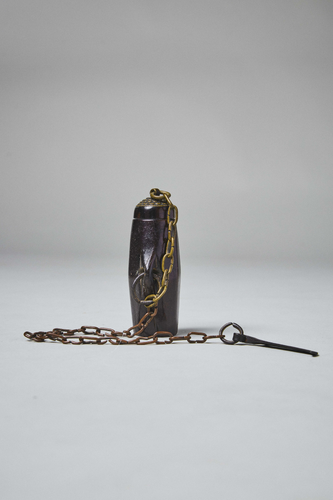
Small Lacquered Powder Flask (Kayaku-ire)
| Origin | Japan |
|---|---|
| Century | Edo period, 19th century |
| Medium | Lacquer |
| Dimensions |
Height11 cm / 4 21⁄64 in
|
| Condition | Good |
Publication
- With Patrick Mesdag Gallery, Belgium
- With, Düsseldorf, Germany
- Private collection, Germany
Short Description
A small powder flask for a matchlock gun, with a slender body that swells slightly at the middle and has softly faceted sides. It is covered in a glossy dark lacquer with a deep purplish tone.
The top is a separate lacquered cap crowned by a brass finial modelled as a chrysanthemum flower head, which holds the chain. On one side, a raised lug carved with pointed, leaf-like forms holds an iron ring. The chain runs through this ring, changing from brass to copper links, and ends in an iron pricker for clearing the touch-hole of the gun. Its compact size and the attached pricker show it was carried close at hand, ready for use while firing.
Kayaku-ire is the general Japanese term for a gunpowder flask. From the arrival of the matchlock in Japan in 1543 until the end of the Edo period, a gunner worked with two kinds of powder. The coarser main charge (dōgusuri) was poured down the muzzle before the ball. The finely ground priming powder (kuchigusuri) was placed in the small pan beside the touch-hole, where the glowing match cord ignited it and set off the main charge. Each powder had its own container: a larger flask for the main charge, often with a lid that measured a single shot, and a smaller flask for the priming powder.
Flasks were made of wood, bamboo, horn, gourd or tortoiseshell, and were often lacquered or covered in leather. Many were made in matching pairs and decorated with the owner's family crest, which made them personal objects as well as equipment.
Condition: Good; light surface scratches and minor wear to the lacquer consistent with age and use, oxidation to the iron ring and pricker, and natural patina to the chain.