Ref. No. 631
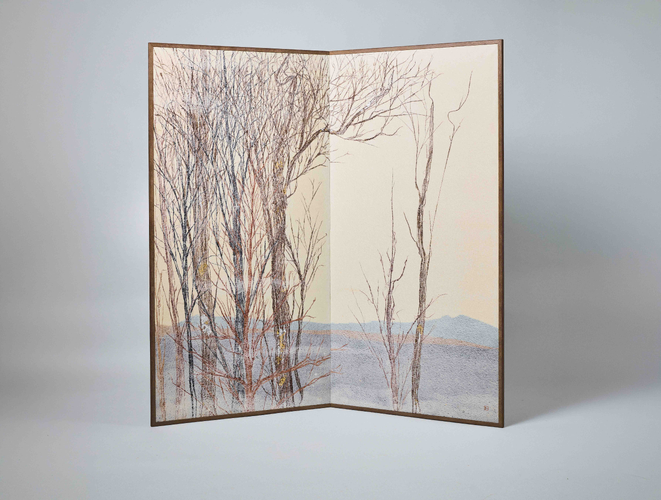
Two-Panel Folding Screen with Bare Trees and Distant Hills by Issei YAMAUCHI
| Origin | Japan |
|---|---|
| Century | second half of the 20th century |
| Medium | Paper |
| Dimensions |
Height155 cm / 61 1⁄32 in
Width155 cm / 61 1⁄32 in
|
| Condition | Very Good |
| Signature | artist's seal, lower right |
Provenance
- Private Japanese collection
Short Description
The whole image on this two-panel folding screen is made from dyed paper rather than paint. A stand of leafless trees rises across the left panel. Their trunks and branches are built up from twisted strands of kozo (paper mulberry) fibre in brown, rust red, charcoal and white. One bough reaches across the fold into the largely open right panel, where two slender saplings stand on their own. Parts of the bark are picked out in silver leaf, with small touches of gold suggesting lichen. Behind the trees, a low range of hills is laid in as bands of blue-grey and soft pink pulp with a granular, lace-like surface, set against a pale cream sky. The reverse is covered with a striated paper in purple and grey-blue, and the panels are held in a plain wooden frame.
Yamauchi Issei, whose given name is officially read Kazuo, was born in 1929 in Obara village, Aichi Prefecture, now part of Toyota City. In 1947 he began studying under the craft artist Fujii Tatsukichi (1881–1964), who had moved to Obara during the war and turned the village's handmade paper into an artistic medium. Yamauchi developed the technique further, layering washi in many colours to achieve painterly effects, and came to be regarded as the leading master of Obara paper art. His work was first accepted at the Nitten in 1953. He received a special prize (tokusen) there in 1965, served as a juror from 1974, and won the Prime Minister's Prize in 1997 for his work Hakufu. In 1959 he made a pair of six-panel screens presented for the wedding of the Crown Prince. Aichi Prefecture also chose his works as official gifts to American diplomats, among them Ambassador Edwin O. Reischauer. His honours include a commendation from the Minister of Education for contributions to regional culture (1996), the Chunichi Culture Prize (1999) and the Order of the Rising Sun, Gold Rays with Rosette (2007).
Works by YAMAUCHI Issei can be found in the Kariya City Art Museum, the Obara Paper Art Museum in Toyota and the collection of the Imperial Household.
Condition: Very good, there are a few small surface marks on the back.