Ref. No. 691
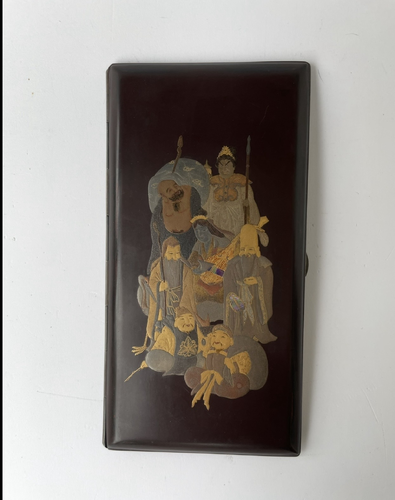
Lacquer Cigarette Case with the Seven Lucky Gods
| Origin | Japan |
|---|---|
| Period | Meiji period (1868–1912) |
| Medium | Lacquer |
| Dimensions |
Height16.2 cm / 6 3⁄8 in
Width8.4 cm / 3 5⁄16 in
|
| Condition | Very Good |
| Signature | indistinctly, in gold lacquer on the reverse |
Provenance
- Y. Kolodotschko collection, Munich
- Van Dijk collection, The Netherlands
Short Description
A rectangular case with a black roiro lacquered exterior, set in a metal frame with a push-button clasp. On the lid the Shichifukujin, the Seven Lucky Gods, are gathered in a lively group, built up in gold and silver takamaki-e with inlaid aogai and detailed with great finesse. The interior is lacquered in dense nashiji and retains its original metal spring bar for holding the cigarettes.
The Shichifukujin are an eclectic group of deities of very different origins. Ebisu, patron of fishermen and trade, is the only one native to Japan. Daikokuten, Bishamonten and Benzaiten came from India by way of Buddhism, while Hotei, Fukurokuju and Jurojin derive from Chinese Daoist and Buddhist tradition.
Although each was originally worshipped separately, they were first brought together as a group in the Muromachi period (1336–1573). During the Edo period (1615–1868) they became particularly popular with urban merchants and artisans as bringers of wealth, good fortune and longevity. They are often shown together aboard the takarabune, the treasure ship believed to bring good fortune at New Year. On this lid all seven can be recognised by their attributes: Hotei with his sack, Bishamonten in armour with his spear, Benzaiten with her lute (biwa), Fukurokuju with his crane, Jurojin with a staff bearing a scroll, Ebisu with his fishing rod and sea bream, and Daikokuten seated on his rice bales.
Condition: Very good; the black roiro lacquer has faded to a warm dark brown with age; light surface scratches, chiefly to the reverse, and minor wear to the metal mounts.