Ref. No. 630
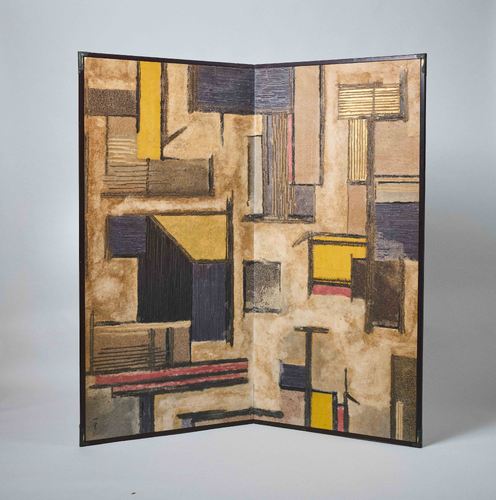
Two-Panel Folding Screen with Abstract Composition by Issei YAMAUCHI
| Origin | Japan |
|---|---|
| Period | Heisei period (1989-2019) |
| Medium | Paper |
| Dimensions |
Height156 cm / 61 27⁄64 in
Width156 cm / 61 27⁄64 in
|
| Condition | Very Good |
| Signature | Issei, with seal |
Provenance
- Private Japanese collection
Short Description
Two-Panel Folding Screen with Abstract Composition by YAMAUCHI Issei (1929–2024) Japan, Heisei period (1989–2019) Signed: Issei, with seal.
A two-panel folding screen made in the Obara washi technique, in which dyed papermulberry fibre is used as pigment and set into the sheet while it is formed. Interlocking rectangles and bars in ochre, saffron yellow, violet-blue, charcoal, dusty pink and greybrown are spread across both panels on a mottled buff ground. Each field is edged with soft, feathered fibre. Some fields are worked in relief, with close vertical ribbing and horizontal ridges that have a golden sheen and give the surface an almost textile depth. The screen is mounted in a dark lacquered frame with metal corner fittings, and the reverse is backed with plain paper.
YAMAUCHI Issei, whose given name is officially read Kazuo, was born in 1929 in Obara village, Aichi Prefecture, now part of Toyota City. In 1947 he began studying under the craft artist Fujii Tatsukichi (1881–1964), who had moved to Obara during the war and turned the village's handmade paper into an artistic medium. Yamauchi developed the technique further, layering washi in many colours to achieve painterly effects, and came to be regarded as the leading master of Obara paper art. His work was first accepted at the Nitten in 1953. He received a special prize (tokusen) there in 1965, served as a juror from 1974, and won the Prime Minister's Prize in 1997 for his work Hakufu. In 1959 he made a pair of six-panel screens presented for the wedding of the Crown Prince. Aichi Prefecture also chose his works as official gifts to American diplomats, among them Ambassador Edwin O. Reischauer. His honours include a commendation from the Minister of Education for contributions to regional culture (1996), the Chunichi Culture Prize (1999) and the Order of the Rising Sun, Gold Rays with Rosette (2007). Works by YAMAUCHI Issei can be found in the Kariya City Art Museum, the Obara Paper Art Museum in Toyota and the collection of the Imperial Household.
Condition: Very good, with a few small surface marks on the back.