Ref. No. 582
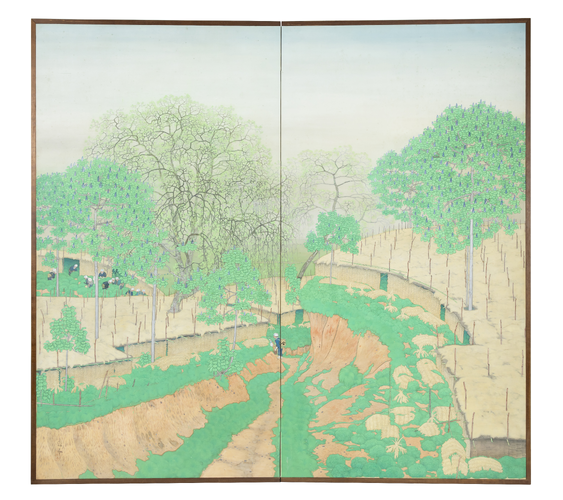
Two-Panel Screen with Tea Picking at Uji Japan
| Origin | Japan |
|---|---|
| Period | Showa period (1926-1989) |
| Medium | Silk |
| Dimensions |
Height175 cm / 68 57⁄64 in
Width187 cm / 73 5⁄8 in
|
| Condition | Very Good |
| Signature | Signed (artist unidentified) |
Provenance
- Commissioned by a Kanbayashi tea merchant, Uji
- Private Japanese collection
Short Description
A two-panel folding screen painted in mineral pigments on silk with a view of the tea gardens of Uji in early summer. A sunken lane leads from the foreground into the distance between eroded banks of ochre and rose-pink earth, softened by tufts of fresh green growth.
On either side, tea fields lie beneath straw-covered canopies raised on rough wooden poles. In the left panel the canopy opens to reveal a group of pickers in indigo jackets and white headcloths, bent over the rounded tea bushes, while a lone figure makes his way along the path below. Young trees in new leaf, crowned with upright violet blossoms, frame the scene against a great bare-branched tree that dissolves into a pale, misty sky.
The stippled earth, woven straw and densely worked foliage are rendered with a meticulous, almost decorative precision. The reverse is backed with patterned paper and retains the original printed label of the Kanbayashi tea house that commissioned the screen, recording the subject as tea picking.
The Kanbayashi family was among the foremost tea merchants of Uji. Under the Tokugawa shogunate it held the office of head of the official tea masters, and it directed the annual procession that carried Uji's finest tea in sealed jars to the shogun in Edo. Commissioned by one of the family's tea houses, this screen celebrates the harvest on which that trade was built.
Compare:
- Tea Picking at Uji; Tea Party at Yoshida, pair of six-panel screens, ink, colour and gold flecks on paper, 18th–19th century, Los Angeles County Museum of Art (M.86.138.1a-b)
- Tea Production (Seicha-zu byobu), pair of six-panel screens, Edo period, Kyoto Prefecture, recorded by the Agency for Cultural Affairs
Condition:
Very good condition. The screen has been professionally cleaned, with some areas of restoration and retouching. Fine craquelure to the pigment layer and light wear to the frame are consistent with age. The original label on the reverse shows small losses at the edges but remains fully legible.