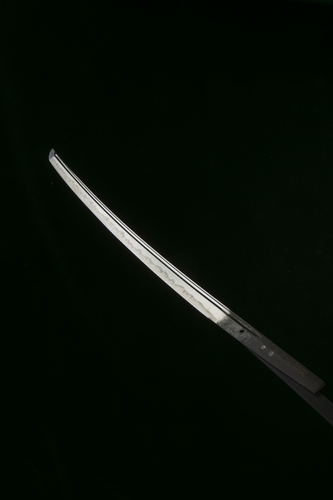
Ref. No. 603
Katana
| Origin | Japan |
|---|---|
| Century | Edo period, Manji–Kanbun era (1658–1673) |
| Medium | Steel |
| Dimensions |
Width65.7 cm / 25 55⁄64 in
|
| Condition | Excellent |
| Signature | Yamato no Kami Yoshimichi |
Provenance
- Private Japanese collection
Short Description
Shinogi-zukuri katana with iori-mune, a wide and thick body, small sori and chu-kissaki, with long bo-hi carved to both sides. The blade is in excellent polish. The nakago is suriage with a kiri-jiri and three mekugi-ana, two of them plugged with lead; the mei remains complete and undisturbed by the shortening. The hamon is a nie-deki midareba, moving from suguha into gunome, with sunagashi, kinsuji and tobiyaki throughout; the boshi is kaeri kitai. Accompanied by an NBTHK Tokubetsu Kicho certificate (no. 322918) and a plain shirasaya.
Yamato no Kami Yoshimichi was the second son of the first generation Osaka Tanba no Kami Yoshimichi and worked within the Mishina school, a lineage founded by the swordsmith Kanemichi of Mino province, who moved to Kyoto to establish it. He was counted among the three great masters of choji-midare in the Kansai region. For a time he worked in Himeji in Harima province, and his blades are therefore popularly known as "Himeji Yamato". In his later work he used the kusuriyakiba technique to render motifs such as chrysanthemums on flowing water, Mount Fuji and cherry blossoms. The Kaiho Kenjaku of 1797 rates him yoki-wazamono. The name Yamato no Kami Yoshimichi was carried on for three generations.
Measurements: Nagasa 65.7 cm; motohaba 3 cm; sakihaba 2 cm; sori 1.2 cm; kasane 0.7 cm