Ref. No. 597
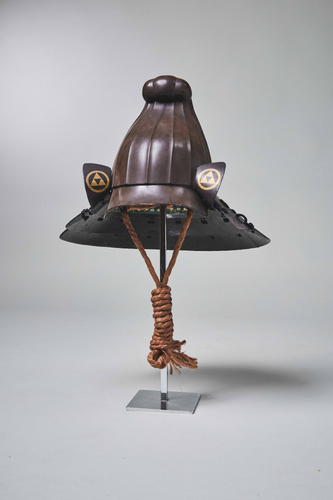
Wave Form Kawari Kabuto with Mitsuuroko Crest
| Origin | Japan |
|---|---|
| Century | mid Edo period |
| Medium | Iron |
| Dimensions |
Height32 cm / 12 19⁄32 in
Width42 cm / 16 17⁄32 in
|
| Condition | Very Good |
Provenance
- Private collection, the Netherlands
Short Description
A kawari kabuto in the form of a wave, combining a bowl of nerigawa (leather hardened and shaped before lacquering) with iron. The tall bowl rises in a series of vertical flutes, like a swell gathering strength, and breaks at the crown into a rounded crest curling forward over the brow, the whole finished in a lustrous black-brown lacquer. The lacquered iron peak (mabizashi) shades the brow, its underside lacquered red. The turned-back fukigaeshi each carry a crest of three scales within a circle (maru ni mitsuuroko) in gold lacquer on a dark ground. The crest of three scales recalls the legend told in the Taiheiki, in which the goddess Benzaiten appeared to Hojo Tokimasa on the island of Enoshima and vanished into the sea as a great serpent, leaving three scales behind. Below hangs a flaring three-lame shikoro of lacquered iron, purple-brown outside and black inside, laced with widely spaced pairs of dark blue braid (sugake odoshi). Inside, the bowl keeps its blue textile lining with a border of small yellow flowers, and the helmet retains its thick twisted chin cord (shinobi-no-o).
Kawari kabuto, helmets of unconventional form, became fashionable from the late Muromachi period onwards, as warriors began to express personal taste in their armour. On crowded battlefields a distinctive silhouette made a commander recognisable at a distance. Forms were drawn from headgear, animals, objects and the natural world, and were often built up in leather, paper or thin iron over a simple bowl. In the peaceful Edo period such helmets became showpieces of craftsmanship and markers of their owner's standing. The wave was among the motifs chosen for its force and movement.
Compare: Helmet (Kawari-Kabuto) in the Shape of a Wave, Japan, 17th century, The Metropolitan Museum of Art, New York, 2018.833.8a, b – Wave-Crest Helmet with Silver Finish, Japan, mid Edo period, Fukuoka City Museum.
Certificate: Kicho Shiryo no. 1314, Nihon Katchu Bugu Kenkyu Hozon Kai, 2023
Condition: Good overall, with wear consistent with age and use. The lacquer shows general surface wear and light scratching, most visible on the peak and bowl, with small chips and losses along the edges of the shikoro lames and the fukigaeshi. The gold-lacquered crests show minor wear, with a fine surface line across one. One of the pins attaching the shikoro to the bowl is missing. The textile lining has a few small holes and spots.