Ref. No. 596
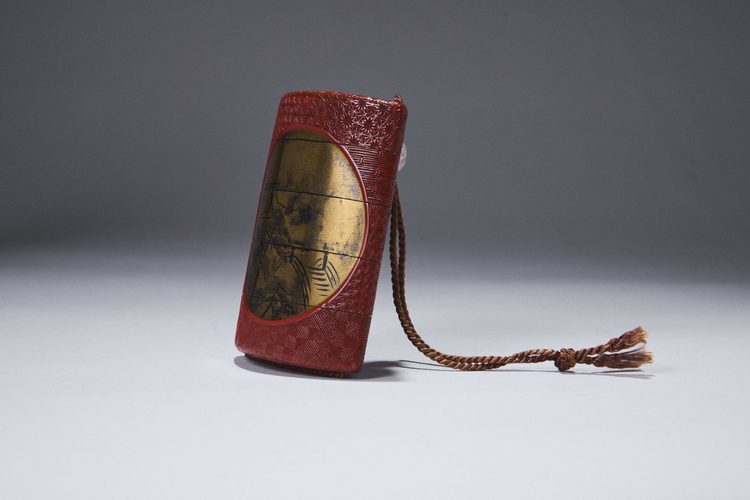
Four-Case Inro with Landscape and Wisteria Medallions by Kansai I KOMA
| Origin | Japan |
|---|---|
| Century | second half of the 18th century |
| Medium | Lacquer |
| Dimensions |
Depth2.2 cm / 0 55⁄64 in
Height7.9 cm / 3 7⁄64 in
Width5.7 cm / 2 1⁄4 in
|
| Condition | Very Good |
| Signature | Kansai |
Provenance
- • Arthur Kay, F.S.A., Glasgow, London and Edinburgh (with his collection label, no. 0429)
- • His sale, Hôtel Drouot, Paris, 1913, lot 234
Literature
- • Melvin and Betty Jahss, Inro and Other Miniature Forms of Japanese Lacquer Art, Rutland and Tokyo: Charles E. Tuttle, 1971, pp. 417–418
- • E.A. Wrangham, The Index of Inro Artists, ed. Joe Earle, Alnwick: Harehope Publications, 1995, pp. 112–113
Expertise
- 234 Compare:
- • Kansai, inro with bamboo in takamaki-e on a silver ground within a tsuishu frame, Naprstek Museum, Prague; recorded in E.A. Wrangham, The Index of Inro Artists, 1995, p. 112
- • KOMA Kansai, five-case inro with a crow on a tree trunk in sumie togidashi on a silver ground; published in Melvin and Betty Jahss, Inro and Other Miniature Forms of Japanese Lacquer Art, Rutland and Tokyo: Charles E. Tuttle, 1971, p. 378, pl. 231
Short Description
A four-case inro of rounded rectangular section, framed in carved red lacquer (tsuishu). The frame is cut in a patchwork of crisp geometric diapers, among them hemp-leaf (asanoha), key-fret (sayagata), concentric lozenges and rosettes within a diamond lattice, which continue over both ends and around the cord channels. Each face has a circular gold-ground medallion, and the two are worked in deliberately contrasting techniques. On one, a lakeside landscape with a temple roof, pines and an arched bridge is rendered in sumie togidashi, polished perfectly flush with the ground in the manner of an ink painting. On the other, sprays of flowering wisteria hang among bamboo leaves and stems in raised gold takamaki-e, against a darker ground clouded with gold. The interiors and rims are lacquered black.
KOMA Kansai I (d. 1792), born Sakanouchi Jubei, was the outstanding pupil of the Edo lacquerer KOMA Koryu I, from whom he received the Koma name. Melvin and Betty Jahss credit him with restoring the family's work to its original high standard. E.A. Wrangham counts him and his eldest son, KOMA Kansai II (1767–1835), among the greatest of all inro artists, and notes that their work is often hard to tell apart. Sumie togidashi, a polished-out technique that imitates ink painting, is closely associated with the Kansai name. Wrangham records that Kansai I was best known for it, especially for delicate landscapes in the style of Song painting, and the landscape on the present inro is executed in exactly this technique. Kansai II worked for the shogun Tokugawa Ienari until his retirement in 1824, and was the first teacher of SHIBATA Zeshin (1807–1891). Inro with a maki-e design set within a carved red lacquer frame are rare in the Kansai work. Wrangham singles out an example in the Naprstek Museum, Prague, as unusual for exactly this feature.
Catalogue de l'importante collection de M. Arthur Kay, de Glasgow, Paris: Hôtel Drouot, 1913, p. 54, no.
Condition: Very good condition. Professionally cleaned; small retouches along the case joins on both medallions