Ref. No. 531
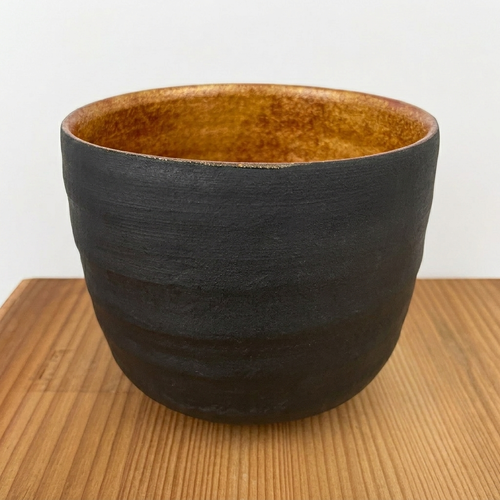
Kokuto Teabowl by Jinnai SAKATA
| Origin | Japan |
|---|---|
| Period | Heisei period (1989-2019) |
| Medium | Ceramic |
| Dimensions |
Height9.5 cm / 3 47⁄64 in
Diameter11 cm / 4 21⁄64 in
|
| Condition | Very Good |
| Signature | impressed seal to the base |
Provenance
- Private Japanese collection
Short Description
A teabowl of deep, gently swelling form, its walls drawn up in soft undulations from a rounded base to a thin, straight rim. The bowl is made in kokuto, stoneware darkened by smoke in the kiln, and here the firing has taken the whole exterior to an even, velvety black. Fine horizontal striations from the throwing run across the matt surface, and a slight shift in tone marks a band around the lower body. The interior is lacquered in deep red and dusted with gold powder, which settles unevenly so that the red shows through in warm, cloudy patches and the whole surface glows amber. A few gold flecks catch along the rim. Against the dark, almost mineral exterior, it gives the bowl a sense of hidden warmth.
SAKATA Jinnai was born in Tokyo in 1943. In 1964 he became a pupil of KAMODA Shoji (1933–1983), who had set up his kiln in Mashiko in 1959, and two years later Sakata built his own climbing kiln at Kami-Oba in Mashiko. From 1971 he held regular solo exhibitions in Tokyo, first at the Akasaka Green Gallery and from 1987 at Nihonbashi Takashimaya, and in 1994 he took part in the opening exhibition of the Art Gallery Takashimaya in New York. In the 1990s his practice widened beyond clay, combining smoke-blackened stoneware with washi paper and later with glass and metal. His work is in the collections of the British Museum, London, and Waseda University, Tokyo.