Ref. No. 483
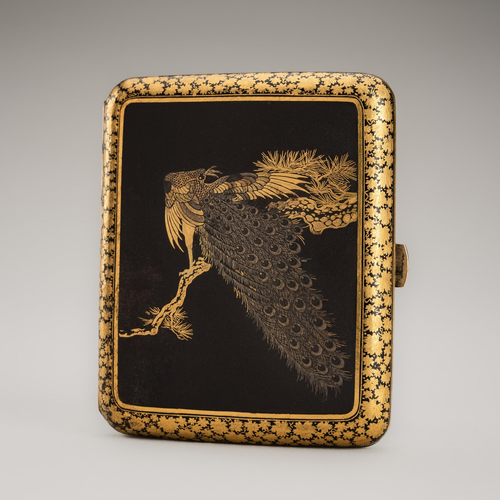
Komai Style Cigarette Case with Peacock and Pine
| Origin | Japan |
|---|---|
| Period | Meiji period (1868–1912) |
| Medium | Iron |
| Dimensions |
Height8 cm / 3 5⁄32 in
Width7 cm / 2 3⁄4 in
|
| Condition | Very Good |
| Signature | Kuriyama tokusei |
Provenance
- Private Dutch collection
Short Description
A cigarette case of rounded rectangular form with softly cushioned sides and a pushpiece clasp at one edge, the blackened iron ground inlaid in gold and silver hirazogan. On the cover, a peacock has settled on a gnarled pine bough that reaches in from the lower left. The bird turns its head back over its shoulder, its wings half raised, while the long train falls in a sweeping diagonal across the panel. Each eye of the train is picked out individually in fine line, and clusters of pine needles fan out above and below the branch. The scene sits within a narrow gold fillet, and the sides are wrapped in a dense band of gilt leaves on the black ground. Butterflies decorate the reverse.
Damascened iron of this kind is associated above all with the Komai workshop, founded in Kyoto in 1841 by Komai Seibei, which built its reputation on inlaying gold and silver into a finely cross-hatched iron ground. After the 1876 ban on wearing swords, Kyoto metalworkers turned these sword-fitting skills to cigarette cases, boxes and other objects for Western buyers. Many workshops and retailers worked in the same manner, and the term Komai style refers to this wider output.