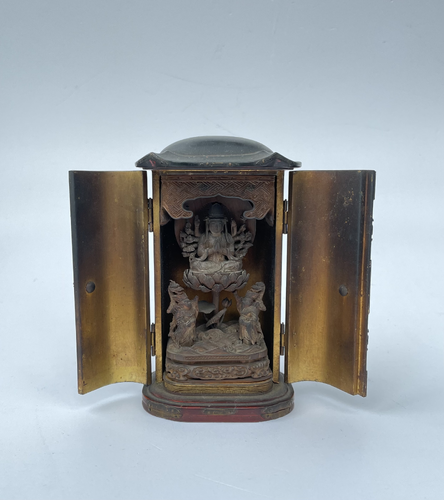
Ref. No. 506
Rare Portable Shrine (Zushi) with Juntei Kannon and Two Dragon Kings
| Origin | Japan |
|---|---|
| Period | Meiji period (1868–1912) |
| Medium | Lacquer |
| Dimensions |
Height12 cm / 4 23⁄32 in
|
| Condition | Very Good |
Provenance
- Private collection, The Netherlands
Publication
- For a study on Juntei Kannon, see: Yoshida, "Zakuro o motsu Juntei Kannon zo ni tsuite: Shinnyo-en Shinchoji shozo no Juntei Kannon Bosatsu gazo o chushin ni", https://glimre.repo.nii.ac.jp/record/2002567/files/kenkyunenpo_69_1_27.pdf
Short Description
A small portable shrine with a rounded body and a domed, flaring roof. It is lacquered black over a red ground, and the black has worn through to the red in places from handling. The doors and base are mounted with gilt metal fittings engraved with scrolling foliage. The doors open onto a gilt interior beneath a carved canopy with a key-fret ground. Inside, the eighteen-armed Juntei Kannon sits on a lotus with the main hands joined in prayer and the other arms fanned out on either side. The lotus stem rises from swirling waves, and a Dragon King stands on each side as its guardian. The group rests on a pedestal carved with clouds.
Juntei Kannon was venerated in the Shingon tradition as one of the Six Kannon, who save beings across the six realms of existence. Prayers to Juntei were offered to avert misfortune and to lengthen life, and especially for children and safe childbirth. Shrines of this miniature scale were made for travel and private devotion, keeping a protective image close at hand.
Compare: Portable shrine with Juntei Kannon, Edo period, 19th century, Penn Museum, Philadelphia (29-156-2)